Joel — The Locusts and the Promise
Joel 1-2 · Bible story for toddlers and preschoolers
When hungry locusts eat every leaf and the land turns bare and brown, God gives His people a beautiful promise that green fields and joy will come again.
The little story (ages 3–6, 7 min)
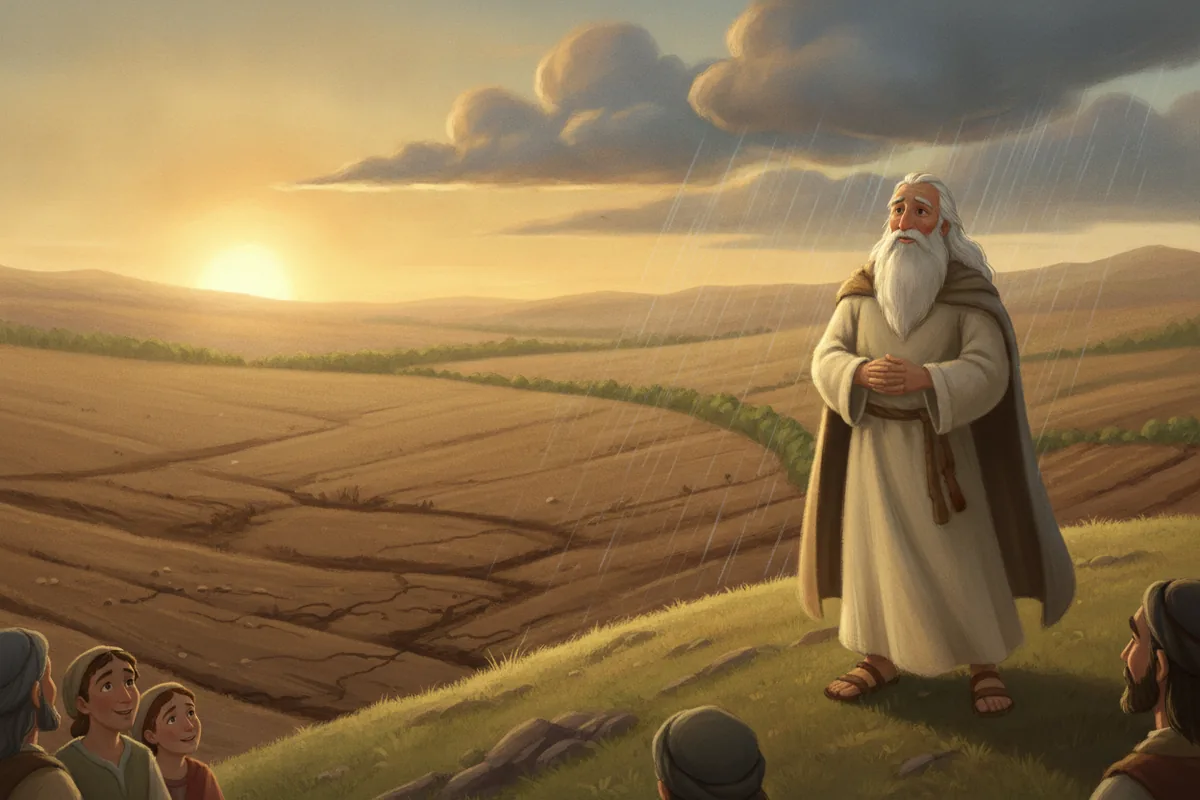
Joel was a prophet – a man who tells God’s words. He lived in a land of fields and fruit trees. But one year, a big trouble came: locusts!
Locusts are hungry bugs, like big grasshoppers. They came in a swarm – a huge crowd of bugs, all flying together. There were so many, nobody could count them. Bzzz! Can you buzz like a locust?
Joel asked the old people, “Has this ever happened in your days?” No, never! Joel said, “Tell your children about it.” And that is why we still tell this story today.
First came one kind of locust. Then came another kind, and another, and another. What one left, the next one ate. Let’s count them on our fingers: one, two, three, four! Munch, munch!
Joel said their teeth were like a lion’s teeth. They ate the wheat and the barley. They ate the grapevines. They ate the fig trees, even the bark – the skin of the tree. The branches were left bare and white.
The pomegranate tree dried up. The palm tree dried up. Even the apple tree dried up! The seeds in the ground did not grow. The barns were empty, with no grain inside.
The cows had no grass, and they groaned. Moo! The sheep had nothing to eat. Even the little streams of water dried up. Joy was gone from the land. But God had not forgotten his people.
Joel prayed, “LORD, I cry to you.” He said that even the animals in the fields were crying out to God.
Then God gave Joel a message. “Yet even now,” says the LORD, “turn to me with all your heart.” To turn to God means to come back to him – like running back into a big hug.
Joel said, “Turn to the LORD, your God; for he is gracious and merciful.” That means God is very kind and loves to forgive.
Joel said, “Blow the trumpet in Zion!” Toot, toot! Can you blow a trumpet? It was time to call everyone to God’s house.
Joel said to gather all the people. The old people should come, and the moms and dads. The children should come, and even the babies! The priests should pray, “Spare your people, LORD.” Spare means “please help them.”
Then the LORD had pity on his people. Pity means he felt sorry for them and wanted to help. But God had not forgotten his people.
The LORD answered, “Behold, I will send you grain, new wine, and oil.” Grain is for bread, and oil is for cooking.
Joel said, “Land, don’t be afraid. Be glad and rejoice.” He told the animals not to be afraid too. The grass would grow green again. The fig tree and the grapevine would have fruit. Can you grow up tall like a little tree?
God would send the rain again, just as before. Pitter, patter! There would be lots of wheat again. But God had not forgotten his people.
God said, “I will restore to you the years that the swarming locust has eaten. You will have plenty to eat and be satisfied.” Restore means to give back. God would give back what the locusts took.
God said, “My people will never again be disappointed.” God is kind. When his people came back to him, he gave them a brand-new start. But God had not forgotten his people.
Talk together
- How do you think the people felt when the locusts ate everything?
- What would you like to eat when the fields are green again?
Memory verse for little ones
“Be glad and rejoice, for the LORD has done great things” — Joel 2:21
Pray together
Dear God, thank you that you are kind and full of love. Thank you for the food you give us. Amen.
The whole story (ages 6+)
Long ago in a land of golden fields and sweet fruit trees, God gave a message to a kind man named Joel. Joel was a prophet, which meant he listened carefully to God and then told the people what God wanted them to know. One morning, God gave Joel a message about a very big day.
Joel looked out over the farms and gardens. Suddenly the sky went dark, not with rain clouds, but with a great cloud of hungry locusts. The little insects came in numbers no one could count, buzzing and fluttering across the fields like a whispering storm.
The locusts landed on everything green. They nibbled the wheat, the grape vines, the fig trees and the olive branches until the whole land looked bare and brown. The people were so sad, for there was little food left. Joel gently told them, "Let us turn our hearts back to God."
Joel reminded the people that God is kind and full of love. He said God is slow to get angry and quick to forgive. "Come back to God with all your heart," Joel said softly. The people did not need to be afraid, because God was still watching over them like a loving Father.
Then Joel shared the most wonderful part of God's message. God said, "I will give the years back that the locusts have eaten." It was a promise to make everything new, to fill the empty fields with waving wheat and heavy fruit once more.
God promised soft rain would fall again, and the dry ground would drink it up. The trees would blossom, the vines would grow sweet grapes, and the barns would be full. Joy would return to the land, and the people would be glad and praise God together.
Best of all, God made an even greater promise. One day He would pour out His own Spirit on everyone, young and old. So the people looked up with new hope, trusting that God always keeps His promises, and that after the hard days, brighter days were surely coming.
Tricky words
- prophet — A prophet is a special person who listens to God and shares God's words with everyone.
- locusts — Locusts are big grasshopper-like insects that fly in huge groups and eat lots of plants.
- forgive — To forgive means to stop being upset with someone and to be kind and friendly again.
- Spirit — God's Spirit is God's own gentle presence that helps and comforts people inside their hearts.
Where is Jesus in this story?
God's promise to Joel to pour out His Spirit came true long after, when Jesus came to rescue us and sent the Holy Spirit to help everyone who loves Him. Just as God promised to make the bare fields green again, Jesus makes our hearts new and fills us with hope. He is the greatest promise of all, showing that God's love always brings us back to life and joy.
God can make things new again
Sometimes hard days come, like when the locusts ate all the crops, and everything can feel sad and empty. But this story shows us that God never stops loving us and He is always ready to bring good things back. God is kind, quick to forgive, and full of hope. When we turn to Him, He can fill our empty places and help green joy grow again.
Memory verse
“I will restore to you the years that the swarming locust has eaten.” — Joel 2:25 · WEB
A little prayer
Heavenly Father, thank You that You are kind and full of love. When days feel hard and empty, help me trust that You can make things new and good again. Thank You for always keeping Your promises. Amen.
Questions kids ask
Why did locusts come in the book of Joel?
Joel describes swarms of locusts that stripped the vines and fig trees bare (Joel 1:4, 7). He used this disaster to call the people back to God with fasting and prayer (Joel 1:14). The Bible doesn't tell us exactly when this locust plague happened.
What does “I will repay you for the years the locusts have eaten” mean?
God promised, “I will repay you for the years the locusts have eaten” (Joel 2:25). The threshing floors would be full of grain again, and the people would eat until they were full (Joel 2:24, 26). It means God can restore what was lost and bring joy after hard times.
What did Joel mean by “rend your heart and not your garments”?
In those days people tore their clothes to show sorrow. Joel said, “Rend your heart and not your garments. Return to the Lord your God, for he is gracious and compassionate” (Joel 2:13). God wants real sorrow on the inside, not just a show on the outside.
When did Joel's promise about God's Spirit come true?
God promised, “I will pour out my Spirit on all people,” sons and daughters, old and young (Joel 2:28). On the day of Pentecost, after Jesus rose and returned to heaven, Peter told the crowd this was exactly what Joel had spoken about (Acts 2:16–17).
Joel — The Locusts and the Promise quiz · Coloring page 1 · Coloring page 2 · Sunday school lesson
Home · All stories · Topics · Coloring pages · Quizzes · Sunday school lessons