Paul in Athens: Proclaiming the Unknown God
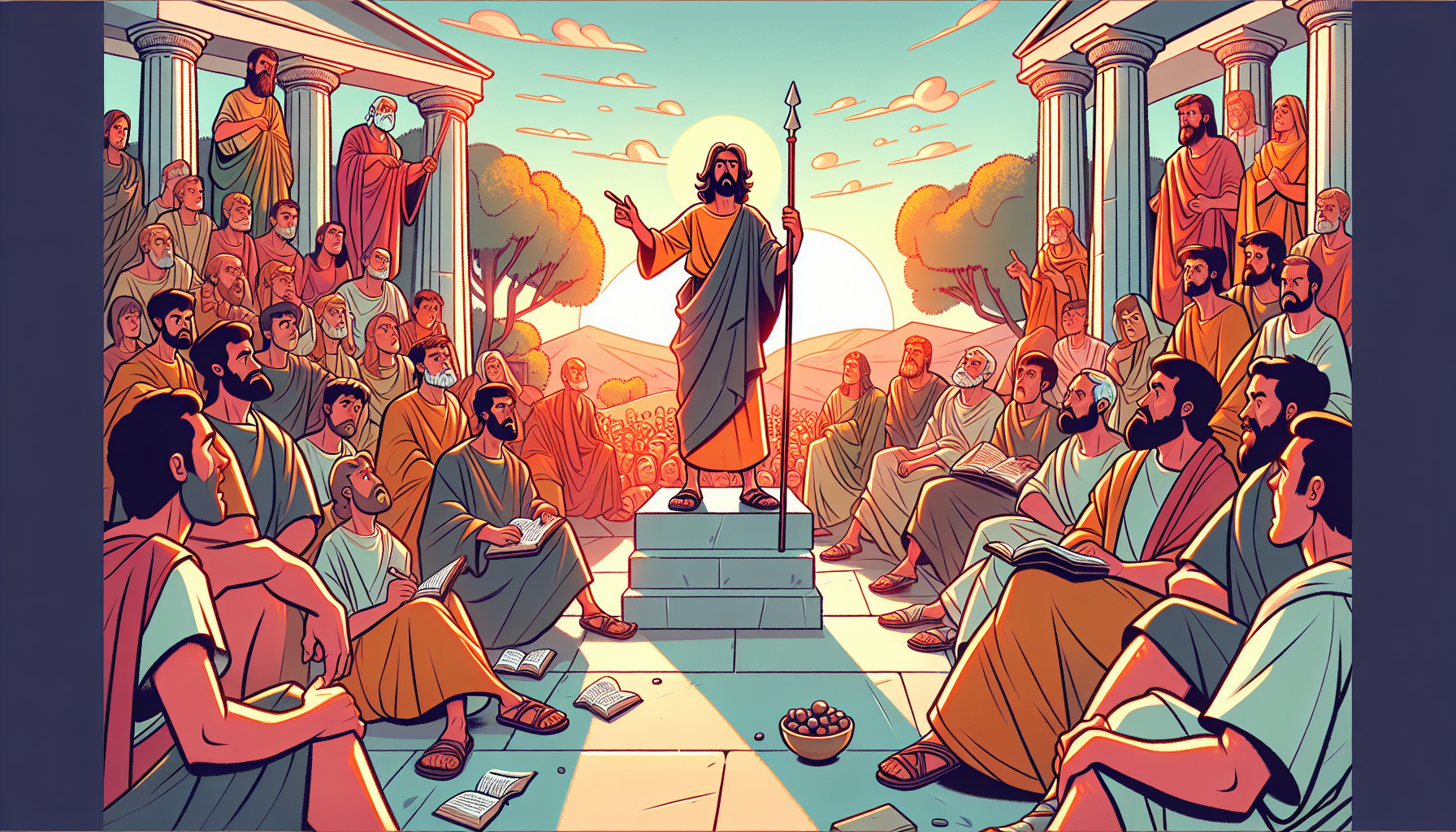
Paul Visits New Cities and Talks About Jesus
Paul and his friends were traveling to tell people about Jesus. They wanted everyone to know how much Jesus loves them.
First, they went to a city called Thessalonica. It was a busy place with many people. Paul went to the big meeting place, called a synagogue, where people came to learn about God. Paul talked to them about Jesus. He told them, "Jesus is the one God sent to save us." Some people listened and felt happy. They believed Paul and wanted to follow Jesus. But some people got angry and did not want to hear about Jesus. They made trouble for Paul and his friends.
So, Paul and his friends left Thessalonica and went to a city called Berea. The people in Berea were very kind. They listened carefully to Paul. They said, "We want to check if what Paul says is true. We will read the holy books ourselves." This made Paul feel glad. He was happy that they wanted to learn the truth about Jesus.
But soon, some people from Thessalonica came to Berea to stop Paul. So, Paul had to leave and went to a city called Athens.
Athens was a very big city with many statues and temples. Paul saw people worshipping many gods. He felt sad because he knew only one true God. He went to the meeting place where people talked about ideas. Paul said, "You are very good at talking about gods. But I want to tell you about the one true God who made everything."
Paul told them about Jesus rising from the dead. Some people laughed. Others wanted to hear more. A few believed Paul. Paul was happy that some people wanted to know Jesus.
Paul thought, "God wants everyone to know about Jesus. I will keep telling them, even if some don’t listen."
Paul’s heart was full of hope and courage. He knew Jesus was with him.
Questions to think about:
-
How do you feel when someone tells you about Jesus?
-
What would you do if some people don’t want to listen?
-
How can you tell others about Jesus like Paul did?
The end.
Memory Verse
"Acts 17:24-25 (WEB) - "The God who made the world and everything in it, he, being Lord of heaven and earth, does not live in temples made by hands; nor is he served by human hands, as though he needed anything; but he himself gives everyone life and breath and all things.""
Discussion Questions
What arguments did Paul use to explain who God is to the Athenians?
How does knowing that God is close to us and desires a relationship affect your faith?
How can you share the message of Jesus with people who have different beliefs or backgrounds?
Coloring Pages
🌈 The Big Talk in Athens! (Acts 17)
Characters:
- NARRATOR
- PAUL
- SILAS
- ATHENIAN 1
- ATHENIAN 2
- GENTILE FRIEND
- GOD’S SPIRIT (voice or puppet)
🌟 Scene 1: A New City, A Big Question
NARRATOR:
Hello friends! Today, Paul and Silas come to a city called Athens. It’s a busy place with many statues and big thoughts. People here wonder, “Who is God?” Let’s see what happens!
PAUL:
(Looks around, curious) Wow! So many statues! Who do you all worship here?
ATHENIAN 1:
We have many gods and goddesses. Sometimes we don’t know who made everything.
ATHENIAN 2:
Yes! We even have a special statue for an “unknown god.” Maybe he can help us!
SILAS:
(Looks at Paul, nods) What can we say about the true God?
PAUL:
(Looks confident) Let’s tell them!
🌟 Scene 2: Paul’s Big Message
NARRATOR:
Paul talks to the people. He tells them about God who made the world and everything in it!
PAUL:
(Puts hand on heart) God made the whole world and all people. He doesn’t live in statues made by hands.
ATHENIAN 1:
(Scratches head) Really? Then who is God?
PAUL:
God made us to live and be happy. He wants us to know Him. And guess what? He sent Jesus to show us His love!
ATHENIAN 2:
(Smiles) Jesus? Tell us more!
PAUL:
Jesus died and came back to life! He helps us be friends with God. We can talk to God anytime!
GENTILE FRIEND:
(Waves excitedly) Wow! This is good news!
GOD’S SPIRIT:
(Voice, softly) I am here for everyone who believes!
🌟 Scene 3: Happy Hearts in Athens
NARRATOR:
Some people listen and believe. Others want to hear more. Paul and Silas are happy because God’s love is going everywhere!
ATHENIAN 1:
(Smiling) I want to know this God who loves us!
ATHENIAN 2:
(Laughs) Me too! This is the best story ever!
PAUL:
(Happily) God loves all people. Let’s love Him back and love each other!
SILAS:
(Claps hands) Yay! Let’s tell everyone!
NARRATOR:
And so, in Athens, God’s love started to shine bright. Remember, friends, God loves you very much!
ALL TOGETHER:
(Giggle and wave) Yay! God’s love is for everyone!
THE END
Mission Relay Race
Materials Needed: Index cards with key words from Acts 17 (e.g., Thessalonica, Berea, Athens, Paul, preaching, mission), cones or markers to set up a relay course.
How to Play:
- Divide the children into two or more teams.
- Set up a relay course with cones or markers.
- Place the index cards at the end of the course.
- One player from each team runs to the cards, picks one, and runs back.
- The team must arrange the cards in the correct order of Paul's mission journey in Acts 17.
- The relay continues until all cards are collected and arranged correctly.
- The first team to finish with the correct order wins.
Connection to Story: This active game helps children learn the key locations and events of Paul's mission in Acts 17, emphasizing the journey and the spreading of the gospel.
Quiet Reflection: Paul's Message Match
Materials Needed: Printed statements or Bible verses from Acts 17, matching cards with simplified explanations or pictures.
How to Play:
- Give each child a set of statement cards and matching explanation cards.
- Quietly, children match the statements or verses with their explanations or pictures.
- After matching, discuss the significance of each message and how Paul shared God's word respectfully and thoughtfully.
Connection to Story: This quiet game encourages reflection on Paul's message in Athens, focusing on understanding and sharing God's truth carefully and respectfully.
Group Challenge: Build the Areopagus
Materials Needed: Building blocks, LEGO, or craft materials; printed pictures of the Areopagus (Mars Hill).
How to Play:
- Divide children into small groups.
- Show them pictures of the Areopagus where Paul spoke in Acts 17.
- Each group works together to build a model of the Areopagus using blocks or craft materials.
- Once finished, groups present their models and explain the significance of the place in Paul's mission.
Connection to Story: This group challenge emphasizes teamwork and helps children visualize the important setting where Paul shared the gospel, reinforcing the theme of mission.
Mission Trivia Quiz
Materials Needed: Prepared trivia questions related to Acts 17 and mission work, a buzzer or bell, scorecards.
How to Play:
- Divide children into teams.
- Ask trivia questions about Paul's mission in Acts 17 and general mission themes.
- Teams buzz in to answer.
- Correct answers earn points; incorrect answers lose points.
- Continue until all questions are asked; the team with the most points wins.
Connection to Story: This fun quiz reinforces knowledge about Paul's mission and the importance of sharing God's word, encouraging engagement and learning.
Teacher's Note: Biblical Background
Teacher's Note
Context
1. Acts 17 describes Paul's missionary journey through Thessalonica, Berea, and Athens, cities in the Roman province of Macedonia during the first century AD. This passage highlights the early Christian mission and the challenges of spreading the Gospel in diverse cultural and religious settings, including Jewish synagogues and Greek philosophical forums. 2. The Roman Empire's political stability allowed for easier travel and communication, but the cultural and religious pluralism often led to conflicts and misunderstandings.
Word Study
1. The Greek word 'kerusso' (to proclaim or preach) is central in this passage, emphasizing Paul's role as a herald of the Gospel. 2. This term underscores the active, public declaration of the message about Jesus Christ, inviting listeners to repentance and faith.
Character Study
1. Paul is the main character, a former persecutor of Christians turned apostle, known for his boldness and theological insight. 2. Silas and Timothy accompany him, supporting his mission. 3. The Thessalonians and Bereans are noted for their varying responses—some eager and open, others skeptical. 4. In Athens, Paul encounters philosophers like the Epicureans and Stoics, illustrating the intellectual challenges to the Gospel.
Core Verse Interpretation
Acts 17:11 highlights the Bereans as 'noble' because they examined the Scriptures daily to verify Paul's teaching. This teaches children the importance of being curious, thoughtful, and diligent in learning about God, encouraging them to explore and understand the Bible for themselves.
Full Scripture Reading (Acts 17)
Lesson Info
-
Time
6-10 Minutes
-
Ages
6-9 Years
-
Theme
Mission

Did you know? Every lesson you read helps support 300 children in our partner school in Uganda.
Learn More